Circuit-level power monitoring: stop guessing which machine is eating your bill
One electricity bill tells you what the whole building used. It cannot tell you which circuit is wasting it. Here is how per-circuit metering changes that, what a real installation looks like, and where the savings actually come from.
Ask most business owners in Seychelles what their biggest machine costs to run and you will get a shrug. The bill arrives once a month, for the whole building, and there is no way to argue with it. You pay it, and you guess.
That guesswork is expensive. In our deployments across Mahé, the pattern repeats: a handful of circuits carry most of the waste, and nobody knows which ones until someone measures them individually.
What circuit-level monitoring actually is
Instead of one meter for the whole property, individual meters are fitted inside the distribution board, one per circuit. Each circuit, the cold rooms, the pumps, the kitchen, the guest wing, the workshop, reports its own consumption continuously.
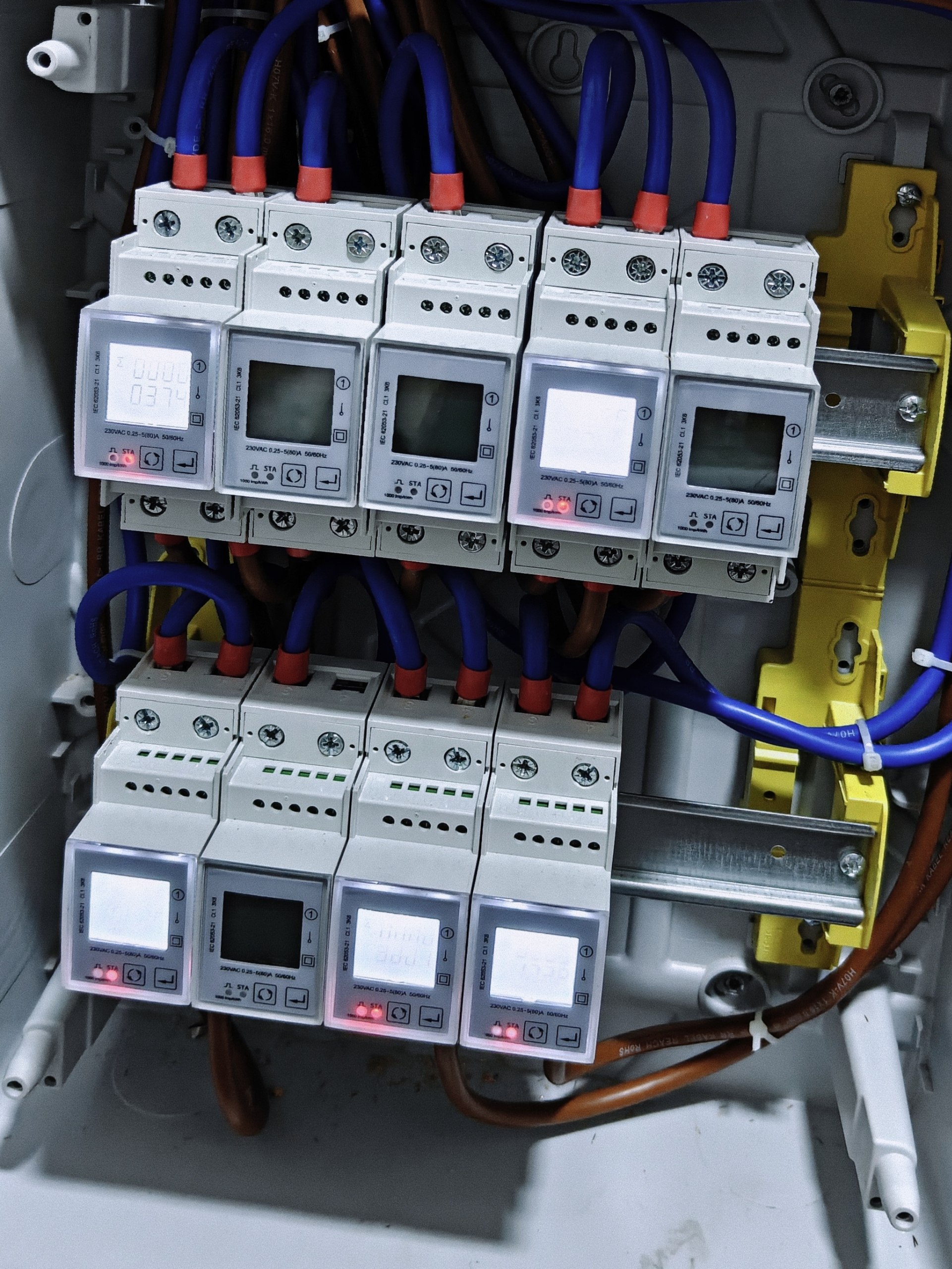
That photograph is a real panel from our current deployment work. Nine circuits, each with its own meter, all reporting live. No guessing, no waiting for the monthly bill.
What you see once every circuit reports
- Live consumption per circuit, readable from a phone anywhere in the world.
- Automatic alerts when a circuit starts drawing more than it should, or runs when it should be off.
- Historical trends, so you can compare this month against last, this season against last season, and prove whether a fix actually worked.
The difference is timing. A conventional bill tells you six weeks after the waste happened. Circuit monitoring tells you the same day, while you can still do something about it.
Where the waste usually hides
In Seychelles properties, the repeat offenders are consistent:
- Refrigeration and cold rooms running above spec because door gaskets leak cold air all day.
- Pumps and water heating cycling on schedules nobody has reviewed in years.
- Empty wings and back-of-house areas heated, cooled or lit as if fully occupied.
- Equipment left on overnight because switching it off is nobody’s specific job.
None of these show up clearly on a whole-building bill. All of them show up immediately on a per-circuit view.
What it takes to install
Sub-metering is fitted inside the existing distribution board by a qualified electrician, circuit by circuit. No rewiring of the property, no disruption to daily operations, and the monitoring layer connects back to a dashboard you already control. Properties with existing metering can usually be expanded the same way, one panel at a time.
We are currently expanding this monitoring infrastructure for clients across Seychelles, alongside water and fuel monitoring on the same platform. If it runs, it can be watched.
The honest bottom line
Monitoring does not save energy by itself. It shows you exactly where the energy is going, early enough to act. The savings come from what you fix once you can see. Businesses that act on what the data shows typically recover the installation cost within months, not years, because the waste was there all along.
If you want to know which machine in your business is quietly eating your bill, the answer is not a bigger guess. It is a meter on that circuit.
Talk to us about a site assessment: info@cyborgcorpsolutions.com | +248 4 303 310 | +248 2 516 949
Want to talk about what this would look like for your operation?
Book a free consultation. We listen first, propose only what makes sense, and walk away when the numbers do not work.